AES/EBU
The XLR AES/EBU input and output are transformer-balanced and ground-free. The incoming channel status is ignored. Connection is accomplished using balanced cables with XLR plugs.
AES/EBU (and SPDIF) can contain Emphasis information. Audio signals with Emphasis have a strong high frequency boost, requiring high frequency attenuation on playback.
| An Emphasis indication gets lost as there exists no standardized interface on computers to handle this information! |
Input
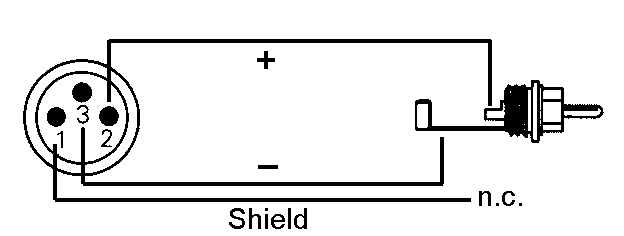
Thanks to a highly sensitive input stage, the SPDIF coaxial signal can also be received using a simple phono-to-XLR cable adapter. To accomplish this, pins 2 and 3 of a male XLR plug are each connected to the two pins of a phono (Cinch/RCA) plug. The cable shielding is connected only to pin 1 of the XLR plug and not to the phono plug.
Output
Using the cable adapter XLR/phono described above, devices with coaxial SPDIF interface can be connected to the AES output of the HDSPe AoX-M as well. Note that most consumer equipment with phono (SPDIF) inputs will only accept signals having a Channel Status 'Consumer' format. The Consumer status is activated in the Settings dialog. The output voltage does not change when switching between professional and consumer format.
| Most SPDIF inputs handle the higher voltage of AES/EBU outputs without problem. If in doubt, contact the manufacturer of the device you want to connect to. |
The output signal coding of the HDSPe AoX-M has been implemented according to AES3-1992 Amendment 4:
-
44.1 / 48 kHz, 88.2 / 96 kHz, 176.4 / 192 kHz depending on the current sample rate
-
Audio use
-
No Copyright, Copy permitted
-
Format Professional or Consumer
-
Category General, Generation not indicated
-
2-Channel, No Emphasis